What Is Azure AI Search and How Does It Support RAG?
Last updated: 20 Aug 2026
53 Views

Introduction:
The use of AI applications today has become more effective with the integration of companies' own documents, databases, websites, and corporate knowledge. Nevertheless, language models cannot access all the information that is kept within the company's private database. Thus, the question arises – how can an AI application access the needed information to generate a relevant response? The Azure AI Search service makes the process of finding and retrieving the information possible and can be applied in RAG applications. Thanks to the combination of searching technology and generative AI, organisations can develop applications that will access the needed information and then generate the answer using AI. It is vital for professionals who explore the topic of Azure Training to understand the technology of Azure AI Search and RAG.
What Is Azure AI Search?
Azure AI Search is a cloud service that provides an application a way to discover information from vast amounts of data sources. The tool allows working with a variety of data types, including documents, structured data, files, and other data assets. Keyword search is used to look for specific words or phrases. Modern applications require something more than just this. Users can formulate questions using their own language and without knowledge of the exact terminology used in the documents. This allows the use of this search in applications when it is necessary to search for information by keywords and by meaning. Azure AI Search includes features like:
- Full-text search.
- Semantic search.
- Vector search.
- Hybrid search.
- Filtering.
- Faceting.
- Ranking.
- AI enrichment.
What Is RAG?
Retrieval-Augmented Generation, commonly called RAG, is an architecture that combines information retrieval with generative AI. Instead of asking a large language model to answer a question entirely from its pre-existing knowledge, a RAG application first searches a relevant knowledge source. The retrieved information is then provided to the AI model as context. A simplified RAG workflow looks like this:
User Question → Search → Relevant Information → AI Model → Generated Answer
For example, imagine an employee asks:
"What is our company's reimbursement policy for international travel?"
The AI model may not know the company's internal policy. A RAG application can search the organisation's policy documents, retrieve the relevant section, and provide that information to the model. The model can then formulate an answer based on the retrieved content.
How Does Azure AI Search Support RAG?
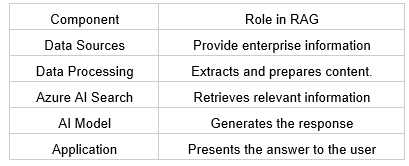
Azure AI Search can serve as the search layer in a RAG pipeline. The indexing of enterprise content is done to help applications find the information needed to answer a particular question. Typically, the first step involves gathering source content, which can be in the form of PDF files, Word documents, websites, databases, product literature, or other forms of an internal knowledge base. Next, the content is processed and indexed to allow for searching of it by the application. In this way, an organisation retains its information separate from the language model. A typical architecture includes:
Vector Search and Semantic Understanding:
One of the crucial ideas that goes into modern-day implementations of RAG is vector search. Texts can be converted into numerical vectors, also known as embeddings, which will include semantic attributes. This way, the search engine will be able to find texts that have a semantically similar meaning to the question asked. For instance, the user could ask:
"How do I get money back for a business trip?"
A document may contain:
"Employee travel expense reimbursement procedure."
A traditional keyword search might struggle because the wording differs. Semantic or vector-based retrieval can recognise that the two concepts are related. This capability can improve the quality of information supplied to the generative AI model.
Hybrid Search for Better Retrieval:
Relying exclusively on either keyword search or vector search may not always produce the best results. Hybrid search combines multiple retrieval approaches. The retrieved results can then be ranked so that the most relevant content is provided to the AI model. This is particularly useful for enterprise applications where users may search using technical terminology, product names, employee terminology, or natural-language questions. For example, an application may consider:
- Keyword relevance.
- Semantic similarity.
- Vector similarity.
- Filters.
- Ranking signals.
The Importance of Data Preparation:
RAG quality depends heavily on the quality of retrieved information. Simply uploading thousands of documents into a search index does not automatically create a reliable AI application. Chunking is particularly important. Extremely large pieces of text may contain too much unrelated information, while excessively small chunks may lose important context. A well-designed indexing strategy can therefore significantly influence RAG performance. Documents often need to be processed before indexing.
- Collecting source documents.
- Extracting text.
- Removing unnecessary content.
- Splitting documents into smaller chunks.
- Creating embeddings.
- Adding metadata.
- Creating searchable indexes.
- Applying appropriate access controls.
Metadata and Access Control:
Enterprise RAG applications often deal with sensitive information. A search system must therefore understand who is allowed to access particular content. Applications can then apply filters to ensure that users retrieve only information they are authorised to see. This is an important consideration when implementing RAG within large organisations. Metadata can be used to identify information such as:
- Department.
- Document type.
- Product.
- Region.
- Publication date.
- Access level.
Why Azure AI Search Matters for Data Engineers?
RAG applications require more than AI models. They depend on well-structured data pipelines, indexing strategies, metadata, security, monitoring, and reliable infrastructure. This makes Azure AI Search particularly relevant to professionals pursuing an Azure Data Engineer Course. Data engineers can be involved in preparing source data, designing pipelines, transforming documents, managing indexes, generating embeddings, and maintaining the data infrastructure that supports AI applications. Understanding the connection between data engineering and AI retrieval can therefore open the door to more modern cloud-data workflows.
Azure AI Search and Cloud Architecture:
RAG applications also require architectural decisions around scalability, security, performance, identity, storage, networking, and integration with other Azure services. This is where cloud architecture knowledge becomes important. Professionals pursuing Azure Solution Architect Certification can benefit from understanding how AI search fits into larger application architectures. An architect may need to determine how search services interact with data sources, AI models, applications, identity systems, and monitoring tools. The architecture should be designed around the organisation's requirements rather than simply selecting individual services.
Real-World Applications of Azure AI Search and RAG:
Organisations can use RAG architectures for a wide range of applications. For example, an organisation could create an internal assistant that searches company documentation and answers employee questions using approved internal sources. Common examples include:
- Enterprise knowledge assistants.
- Customer support chatbots.
- Technical documentation assistants.
- Product recommendation systems.
- Employee policy assistants.
- Legal document search.
- Healthcare information systems.
- Internal research tools.
Conclusion:
Azure AI Search is the key basis for implementing the RAG concept within applications. The ability to use keyword, semantic, and vector searches can be helpful for applications in finding relevant data and then feeding it to the generative AI models. It should be noted that RAG is not about merely connecting a chatbot to the search engine. There should be some careful preparation of the data, effective indexing and retrieval, proper security, model implementation, and evaluation. For those who are developing their career in the cloud, Azure Training can help to get the basic knowledge of the Microsoft cloud system, and the Azure Data Engineer Course can help to understand the data pipeline of AI applications.
Those who are working on Azure Solution Architect Certification will get a chance to learn about Azure AI Search and other Azure services in more detail.
Related Content
Delta Live Tables is useful for data pipelines that need to be reliable, scalable, and easy to operate. Data processing logic, pipeline management, quality checks, etc. combine into one environment.
20 Aug 2026
ITAM is the practice of keeping a record of your tech from the moment you purchase it to the moment you discard it.
2 Sept 2026

Amazon ECR refers to a managed container registry. Teams use it to store Docker images that applications need to run smoothly.
25 Aug 2026
